

AI agents can execute work, not just answer questions. Five processes where they add value, how to start with a pilot, and the risks leaders must manage.
From answering questions to helping organizations execute work
Generative AI has changed how people create content, analyze information and interact with technology. Across organizations, employees are using tools such as ChatGPT, Microsoft Copilot, Claude and Gemini to draft emails, summarize documents, explore data and accelerate everyday tasks. (If you are still choosing between them, see our comparison of Copilot, ChatGPT and Gemini for business.)
But an important business question is emerging:
What happens when organizations move beyond asking AI questions and start using AI to help execute business processes?
This is where AI agents become important.
AI agents can be designed to work towards defined objectives, use approved tools and information sources, perform multiple steps, and interact with business systems within specified permissions. Instead of responding to one prompt and stopping, an agent-enabled workflow can coordinate a sequence of activities.
For business leaders, this represents an opportunity to rethink how work gets done.
In short: AI agents are most useful in repetitive, rule-based processes such as invoices, recruitment, lead follow-up, reporting and customer enquiries. Start with one well-defined process, keep people in charge of important decisions, and measure the results before you scale.
1. From AI conversations to business workflows
A conventional AI assistant typically responds to a user's instruction. An AI-enabled workflow can go further by connecting several activities.
Consider a simple example. An employee receives an invoice by email. Traditionally, someone may need to open the attachment, extract the relevant details, compare them with purchase information, check for discrepancies, update a record and send the document for approval.
An AI-enabled workflow could assist with several of these steps:
- Identify and retrieve the incoming invoice.
- Extract supplier, invoice number, date, amount and line-item information.
- Compare extracted information with available purchase order or supplier records.
- Flag missing information or potential discrepancies.
- Prepare a review summary.
- Route the invoice to an authorized person for approval.
The important point is not that AI should automatically approve every invoice. It is that repetitive preparation and checking activities can be supported by a structured workflow, while important decisions remain subject to appropriate controls.
2. What makes an AI agent different?
An AI agent is not simply a chatbot with a different name. Depending on its design, an agent may combine:
- A defined objective: the task it is expected to help accomplish.
- Instructions and business rules: the boundaries within which it operates.
- Knowledge sources: approved documents, policies, procedures and business information.
- Tools and integrations: the applications or systems it is permitted to use.
- Workflow steps: the sequence of activities required to complete a task.
- Controls and oversight: permissions, approvals, exception handling and human review.
An agent may also be part of a larger workflow involving several agents, automation services and business applications.
The quality of the result depends on the design of the process, the reliability of the information, the available integrations and the controls established by the organization.
3. Five business processes where AI agents can create value
The best starting points are usually processes with recurring activities, structured information, clear rules and measurable outcomes.
A. Human Resources: recruitment and employee onboarding
Recruitment and onboarding involve repeated information-gathering and communication activities. An AI-supported recruitment workflow could help:
- Organize information from incoming CVs.
- Extract qualifications and experience.
- Compare candidate information against approved job criteria.
- Prepare interview questions and scorecards.
- Draft interview summaries for recruiter review.
- Prepare onboarding checklists and welcome communications.
Management consideration: Recruitment decisions should remain accountable to people. AI-generated assessments need human review, appropriate fairness checks and protection of candidate information.
Examples: CV Screening Assistant, Interview Question & Scorecard Builder and Employee Onboarding Agent.
B. Finance: invoice processing and reconciliation support
Finance teams frequently work with invoices, purchase orders, statements and supporting documents. An AI-enabled process could assist with:
- Extracting information from invoices and statements.
- Identifying missing or inconsistent fields.
- Matching records against available reference data.
- Highlighting possible duplicate transactions.
- Preparing exception reports.
- Drafting explanations for unusual variances.
Management consideration: Financial approvals, payment authorization and accounting adjustments should follow established approval controls. AI-generated findings should be checked against source records.
Examples: Invoice Capture & PO Matching and Bank Reconciliation Automation.
C. Sales: lead qualification and follow-up
Sales teams need timely information to prioritize opportunities and maintain communication. An AI-supported workflow could:
- Capture enquiries from approved channels.
- Organize lead information.
- Categorize enquiries using defined criteria.
- Identify missing qualification information.
- Draft personalized follow-up messages.
- Prepare summaries for sales representatives.
- Highlight leads requiring attention.
Management consideration: Customer communications, pricing commitments and important sales decisions should follow approved business rules and authorization requirements.
Example: Website Lead Qualification Assistant.
D. Operations: daily reporting and exception management
Operations teams often spend significant time collecting updates from different sources and preparing status reports. An AI-enabled workflow could:
- Collect information from approved operational reports.
- Summarize delays and exceptions.
- Identify records requiring investigation.
- Prepare daily performance summaries.
- Route issues to the responsible team.
- Draft management commentary for review.
Management consideration: The agent must distinguish verified facts from assumptions. Managers should be able to trace important findings back to their underlying records.
Example: KPI Alerting System.
E. Customer service: knowledge and enquiry management
Organizations often maintain policies, product information, procedures and frequently asked questions across multiple documents. An AI knowledge assistant could:
- Search approved internal knowledge sources.
- Retrieve relevant policy or product information.
- Draft responses to common enquiries.
- Identify questions that require specialist attention.
- Route unresolved cases to the appropriate team.
- Summarize recurring customer concerns.
Management consideration: Responses should be grounded in approved information, with escalation when the system cannot find a reliable answer.
Example: Customer FAQ Knowledge Bot.
4. How an AI-enabled business workflow operates
A typical workflow can be understood through six stages:
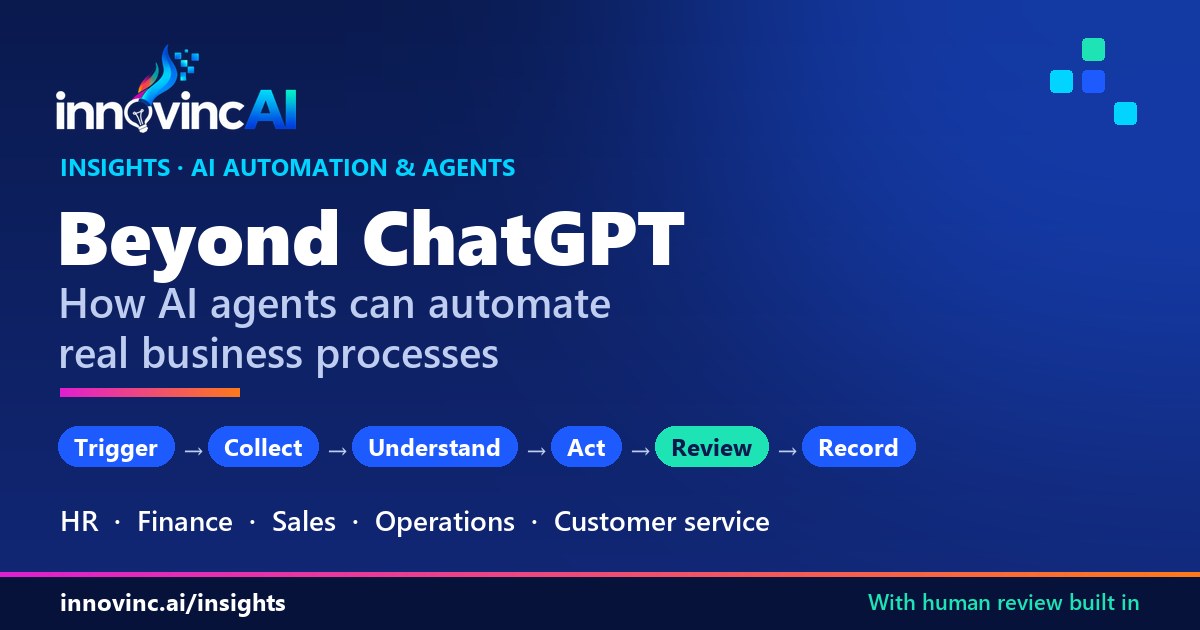
Trigger → Collect → Understand → Act → Review → Record
For example, in an invoice-processing workflow:
- Trigger: A new invoice arrives.
- Collect: The system retrieves the invoice and relevant reference records.
- Understand: AI extracts and interprets the information.
- Act: The workflow performs permitted checks and prepares an exception summary.
- Review: An authorized employee checks discrepancies and approves the next step.
- Record: The outcome and relevant activity are recorded for future reference.
Not every process needs an autonomous agent. Some are better served by conventional automation, document processing or a combination of technologies.
For example, a weaving mill in Pakistan was spending 10 to 12 hours copying yarn demand sheets from PDF into Excel. A focused document-processing tool, not an autonomous agent, now does the job in a few seconds and re-checks every total. Read the weaving mill success story.
The objective should be to select the simplest reliable approach that addresses the business problem.
5. Where should an organization start?
Organizations should not begin by trying to automate everything. A more effective approach is to identify a specific process, understand its current performance and evaluate whether AI can improve it.
A practical starting framework includes five steps.
Step 1: Identify repetitive processes. Look for activities that involve recurring document handling, information searches, classification, reporting, communication or data preparation.
Step 2: Understand the existing process. Document the steps, people involved, systems used, approval points, exceptions and common sources of delay.
Step 3: Assess the data and technology. Determine whether the required information is available, reliable and accessible through approved systems. Check integration requirements and information security considerations.
Step 4: Select a controlled pilot. Choose one clearly defined process. Set boundaries, permissions, escalation rules and human approval requirements before implementation.
Step 5: Measure business performance. Compare the process before and after implementation. Relevant measures may include:
- Processing time per transaction.
- Manual effort required.
- Error and exception rates.
- Rework and correction frequency.
- Response time.
- Cost per completed transaction.
- Employee experience and service quality.
A pilot should be evaluated using evidence, not simply the number of tasks an AI system can perform. For a step-by-step roadmap, see Where to start with AI: a 90-day plan.
6. The risks leaders should consider
AI agents introduce opportunities, but they also create new management responsibilities. Before deploying an agent into a business process, organizations should consider:
- Data protection: What information can the agent access, and how will sensitive data be protected?
- Access permissions: Can it only read information, or can it also create, update or delete records?
- Human approval: Which actions require an authorized employee's approval?
- Accuracy and reliability: How will incorrect outputs, incomplete information and uncertain responses be detected?
- Auditability: Can the organization review what information was accessed, what actions were taken and why?
- Business continuity: What happens when an integration fails, a source document is unavailable or the agent cannot complete a task?
- Governance: Who owns the workflow, approves changes and monitors its performance?
These are not optional considerations. They should be part of the design from the beginning, ideally supported by a clear company AI usage policy.
7. How to evaluate the business value of AI agents
The business case should be based on measurable improvements. For example, an organization could assess a document-processing workflow by examining the number of documents processed, average handling time, manual review effort, error rates and exception volumes.
A useful evaluation compares:
- The existing process cost and performance.
- The expected cost of the AI-enabled process.
- Implementation and integration costs.
- Ongoing licensing, infrastructure and maintenance costs.
- Human review and exception-handling effort.
- The value of improved speed, consistency or service.
It is important to distinguish potential benefits from verified results. A pilot provides evidence that can support a more informed investment decision.
You can get a first estimate in two minutes with our Time & ROI Calculator, then confirm it with a pilot before committing to a wider implementation.
8. The role of leadership in AI transformation
AI agents should not be treated as isolated technology experiments. Successful implementation requires coordination between business leadership, process owners, technology teams, information security, compliance and the employees who perform the work.
Leaders should establish clear priorities:
- Which business processes matter most?
- Which activities are suitable for AI assistance?
- Where must human accountability remain?
- What data and technology capabilities are required?
- How will the organization measure success?
- Who is responsible for ongoing oversight?
The most important decision is not which AI platform to purchase. It is which business problem the organization should solve first.
Conclusion: move from AI experimentation to business execution
ChatGPT and other generative AI tools have made AI accessible to millions of people. The next opportunity for organizations is to apply AI within well-designed business workflows.
AI agents can support activities across HR, Finance, Sales, Operations and Customer Service. But their value depends on selecting the right processes, connecting reliable information, establishing appropriate controls and measuring business outcomes.
Organizations do not need to automate everything at once. They need to start with the right process, build a controlled solution, learn from the results and expand where the evidence supports it.
The future of enterprise AI is not just about asking better questions. It is about redesigning how business work gets done.
How Innovinc AI can help
Innovinc AI works with organizations to explore practical AI opportunities, assess business readiness and design AI-enabled workflows that address real operational challenges. Our areas of focus include:
- AI Transformation Advisory
- AI Automation & Agents
- AI-Powered Analytics
- Corporate AI Training, including Building AI Assistants & Agents and AI Workflow Automation
Start by assessing your organization's AI readiness or estimating the potential value of automation:
Want to explore an AI automation opportunity in your organization? Contact Innovinc AI to discuss the process, business objective and a practical starting point.